
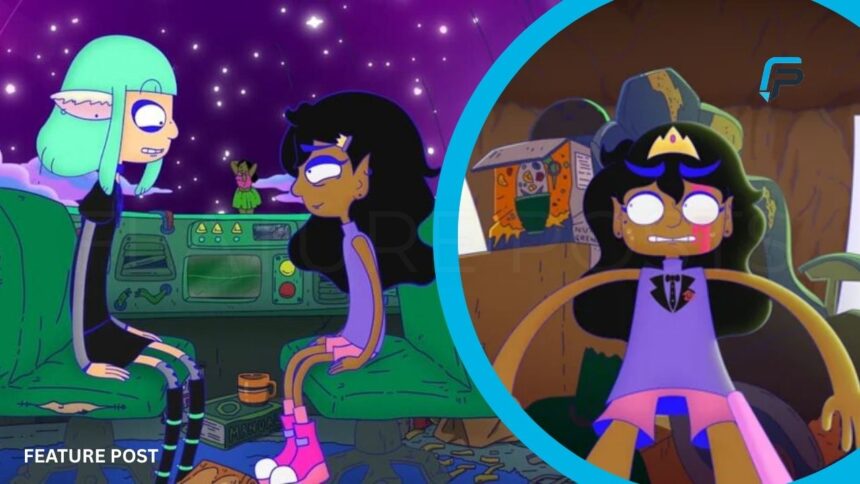
Lesbian Space Princess is one of the most distinctive animated films to emerge from Australia’s independent film scene. Released in 2025, the adult animated sci-fi comedy follows Saira, an introverted princess from the planet Clitopolis. When her bounty-hunter girlfriend Kiki is kidnapped, Saira leaves her sheltered home and begins a chaotic journey through space. The film mixes comedy, romance, fantasy, queer themes, and colorful science fiction into an intentionally unusual adventure.
Behind the unusual title are filmmakers Emma Hough Hobbs and Leela Varghese, who wrote and directed the project together. The film became notable not only for its bold humor but also for its approach to queer representation and self-acceptance. It premiered at the Berlin International Film Festival in 2025 and won the Teddy Award for Best Feature Film. That recognition helped give the Australian production an international profile.
Quick Bio Table Lesbian Space Princess
| Detail | Information |
|---|---|
| Title | Lesbian Space Princess |
| Release Year | 2025 |
| Country | Australia |
| Genre | Animation, Comedy, Romance, Science Fiction |
| Directors | Emma Hough Hobbs, Leela Varghese |
| Writers | Emma Hough Hobbs, Leela Varghese |
| Producer | Tom Phillips |
| Main Character | Princess Saira |
| Saira’s Voice | Shabana Azeez |
| Kiki’s Voice | Bernie Van Tiel |
| Willow’s Voice | Gemma Chua-Tran |
| Runtime | About 87 minutes |
| Production Company | We Made A Thing Studios |
| World Premiere | Berlin International Film Festival, 2025 |
| Major Award | Teddy Award for Best Feature Film |
What Is Lesbian Space Princess?
Lesbian Space Princess is a 2025 Australian adult animated science-fiction comedy with a runtime of about 87 minutes. The story centers on Princess Saira, a young woman whose sheltered life changes after her girlfriend breaks up with her and is later kidnapped. Saira must leave the comfort of her home planet and travel across the galaxy to rescue her former partner. The film uses exaggerated characters and absurd situations to create its distinctive comedic world.
The official film site describes the project as a combination of animation, comedy, fantasy, romance, and science fiction. Its story deliberately places queer characters at the center rather than treating their identities as a side element. The result is a colorful universe filled with unusual planets, drag performers, pop stars, aliens, and a troublesome spaceship. Underneath the wild humor, the story focuses strongly on anxiety, self-worth, and learning to feel comfortable with yourself.
How Did Lesbian Space Princess Begin?
The origins of the film are surprisingly simple. According to the filmmakers, the project began with the title itself. Emma Hough Hobbs came up with the words “Lesbian Space Princess” after an idea struck her while she was taking a shower. She then brought the title to Leela Varghese, and the pair decided to build an entire movie around it. The unusual title therefore became the starting point for the film’s world, characters, and story.
The project was developed through Film Lab: New Voices in South Australia, a program designed to give first-time feature directors an opportunity to make a film. Hough Hobbs and Varghese wanted to create a project that celebrated queer voices while also providing stronger representation for people of color in animation. They ultimately spent about three years bringing the idea from its original concept to a completed feature.
Who Created Lesbian Space Princess?
Emma Hough Hobbs and Leela Varghese served as the film’s writers and directors. Their collaboration brought together different creative strengths. Varghese came from writing and musical comedy, while Hough Hobbs had experience as an animator and writer-director. Their combined interests helped shape a film that could move between visual comedy, musical elements, character-driven storytelling, and imaginative science fiction.
The film was produced by Tom Phillips through We Made A Thing Studios, with additional production involvement from LSP Productions. Hough Hobbs also brought her animation background directly into the project. The filmmakers explained that they wanted animation to make their fictional world feel expansive while still keeping the production rooted in independent filmmaking. Their approach helped the movie develop a colorful visual identity without losing its personal character.
Who Is Princess Saira?
Princess Saira is the central character of Lesbian Space Princess. She is an introverted and anxious royal who has spent much of her life protected from the wider world. Her relationship with Kiki becomes the emotional starting point for her adventure. When Kiki is kidnapped, Saira suddenly has to confront situations far outside her comfort zone. Her journey becomes about much more than rescuing someone she loves.
One of Saira’s biggest struggles involves her own self-doubt. She is expected to possess a powerful royal labrys, but she initially cannot summon it. This becomes a symbolic part of her character arc. Instead of simply becoming stronger through physical action, Saira gradually learns to accept herself. Her emotional development gives the exaggerated science-fiction adventure a more personal foundation.
The Story Behind the Character
Saira begins the film after her girlfriend Kiki ends their relationship, leaving the princess devastated. The situation becomes even more complicated when Kiki is kidnapped by the Straight White Maliens. They demand Saira’s royal labrys as part of their ransom, forcing her to leave her home and begin a dangerous intergalactic mission. The official synopsis describes the journey as a confrontation with both external dangers and Saira’s own self-doubt.
During the journey, Saira encounters Willow, a runaway gay pop idol, and other unusual figures. These encounters challenge her understanding of relationships, independence, and confidence. Rather than making the story solely about winning Kiki back, the film gradually shifts toward Saira’s personal growth. Her adventure ultimately becomes a story about learning that her value does not depend on whether another person chooses to stay with her.
The Meaning Behind the Labrys
The royal labrys is one of the film’s most recognizable fictional elements. Within the story, it represents an extraordinary source of lesbian power and is treated as a crucial part of Saira’s royal identity. However, Saira initially struggles to summon it. That inability reinforces the insecurity she already feels about herself and her place within her family and society.
As the story develops, the labrys becomes closely connected with Saira’s emotional growth. The weapon is not simply a tool that makes her powerful. Her ability to use it reflects her changing relationship with herself. This gives the fantasy element a clear emotional purpose. The filmmakers use the exaggerated mythology of the film to explore ideas about confidence, identity, and self-acceptance.
The Film’s Queer Representation
Queer representation sits at the heart of Lesbian Space Princess. Rather than presenting LGBTQIA+ characters through a tragic or exclusively serious lens, the film embraces comedy, romance, camp, fantasy, and absurdity. The filmmakers have described their goal as creating a world that celebrates queer people while also bringing culturally diverse voices into leading roles.
This approach helped distinguish the film from more conventional queer coming-of-age stories. The Helsinki International Film Festival noted that the movie focuses on the joy of celebrating queerness rather than relying primarily on stories of tragedy or broken characters. That tone is important to the film’s identity. Its colorful universe allows queer characters to exist as heroes, royals, performers, villains, friends, and complicated romantic figures.
Animation and Visual Style
Animation was especially important to the filmmakers because it allowed them to build an exaggerated universe that would have been difficult to reproduce in conventional live action. Hough Hobbs and Varghese wanted the film to feel warm, silly, and inviting while still offering a large science-fiction setting. They used Toon Boom Harmony and combined digital hand-drawn animation with digitally rigged puppets for different sequences.
The finished film has a deliberately bright and playful aesthetic. Its planets, characters, costumes, creatures, and spaceships support the absurd tone of the story. The animation also helps the film move freely between emotional scenes and outrageous comedy. That balance is central to its personality. Instead of aiming for realistic science fiction, Lesbian Space Princess uses animation to create a universe where almost anything can become part of the joke.
Premiere and Major Awards
Lesbian Space Princess received its world premiere at the Berlin International Film Festival in February 2025. The film competed in the Panorama section and won the Teddy Award for Best Feature Film. The Teddy Award is one of the major international honors dedicated to LGBTQIA+ cinema, making the win particularly significant for the Australian production.
The film also collected recognition at other festivals. Screen Australia lists awards including the Teddy Award, the Sydney Film Festival GIO Audience Award, the Sitges Best Film and Best Animated Film honors, and the AACTA Award for Best Indie Film. These achievements helped establish the movie beyond its initial Australian release and demonstrated its appeal to festival audiences.
Release and Reception
The film was released theatrically in Australia on September 11, 2025, after its festival run. It later received releases in additional markets, including the United Kingdom in 2026. The official movie website now lists digital availability through platforms including Apple TV, Amazon, Fandango at Home, and Google Play. Availability can vary by country and platform.
Critical reception has generally highlighted the film’s distinctive queer humor and energetic animation. Rotten Tomatoes currently lists a 96% Tomatometer score based on 54 reviews. Critics have particularly recognized the movie’s combination of queer coming-of-age themes and deliberately outrageous comedy. Its reception also shows how an independently produced Australian animated film can reach audiences well beyond its original market.
The Legacy of Lesbian Space Princess
The legacy of Lesbian Space Princess is still developing because the movie is relatively new. Even so, its festival awards and international distribution have already given it a place within contemporary queer animation. Its strongest contribution may be its willingness to make queer characters the center of a colorful adventure without requiring the story to become a conventional drama. That combination gives the film a distinctive identity.
The film also represents an important step for independent Australian animation. Its creators used a relatively unconventional concept to tell a story about identity, confidence, relationships, and self-love. By placing those themes inside a playful science-fiction universe, they created something that can work as both outrageous comedy and a coming-of-age story. Its continued festival and international presence may help the film develop a lasting cult following.
Why Lesbian Space Princess Stands Out
The biggest reason Lesbian Space Princess stands out is its confidence in its own identity. The title immediately tells audiences that the movie is not trying to be conventional. From its fictional planet and royal labrys to its alien villains and unusual supporting characters, the film embraces its eccentric concept rather than hiding it. That commitment gives the movie a clear personality from beginning to end.
At the same time, the story has a relatable emotional center. Saira’s fears about rejection, loneliness, and self-worth are recognizable even when the world around her is completely fantastical. Her journey suggests that personal confidence cannot always come from romance or external approval. That message gives the outrageous comedy a softer emotional layer and helps explain why the film has attracted attention beyond its novelty.
Conclusion
Lesbian Space Princess began with an unusual title and developed into a colorful Australian animated feature about love, anxiety, identity, and self-acceptance. Emma Hough Hobbs and Leela Varghese built the story around Princess Saira, an introverted royal forced to leave her sheltered life after her ex-girlfriend is kidnapped. The filmmakers used animation to create a playful queer universe while keeping Saira’s emotional journey at the center.
Its Teddy Award win, festival recognition, international release, and strong critical response have helped establish Lesbian Space Princess as a notable contemporary queer animated film. Its legacy will likely depend on how audiences continue to discover it, but its combination of independent filmmaking, bold representation, absurd comedy, and heartfelt character development already gives it a distinctive place in modern animation.
Frequently Asked Questions
What is Lesbian Space Princess about?
It follows Princess Saira as she travels across space to rescue her kidnapped ex-girlfriend Kiki.
Who created Lesbian Space Princess?
Emma Hough Hobbs and Leela Varghese wrote and directed the film.
Who is the main character in Lesbian Space Princess?
Princess Saira is the introverted space princess at the center of the story.
When was Lesbian Space Princess released?
The film was released theatrically in Australia on September 11, 2025.
Did Lesbian Space Princess win an award?
Yes, it won the Teddy Award for Best Feature Film at the 2025 Berlin International Film Festival.
What is the film’s main theme?
The story explores self-worth, self-acceptance, relationships, and overcoming self-doubt.
Is Lesbian Space Princess an animated movie?
Yes, it is an adult animated science-fiction comedy.
Where does Lesbian Space Princess take place?
Much of the story takes place across a fictional queer galaxy, beginning on the planet Clitopolis.
Get More Update FEATURE POSTS