

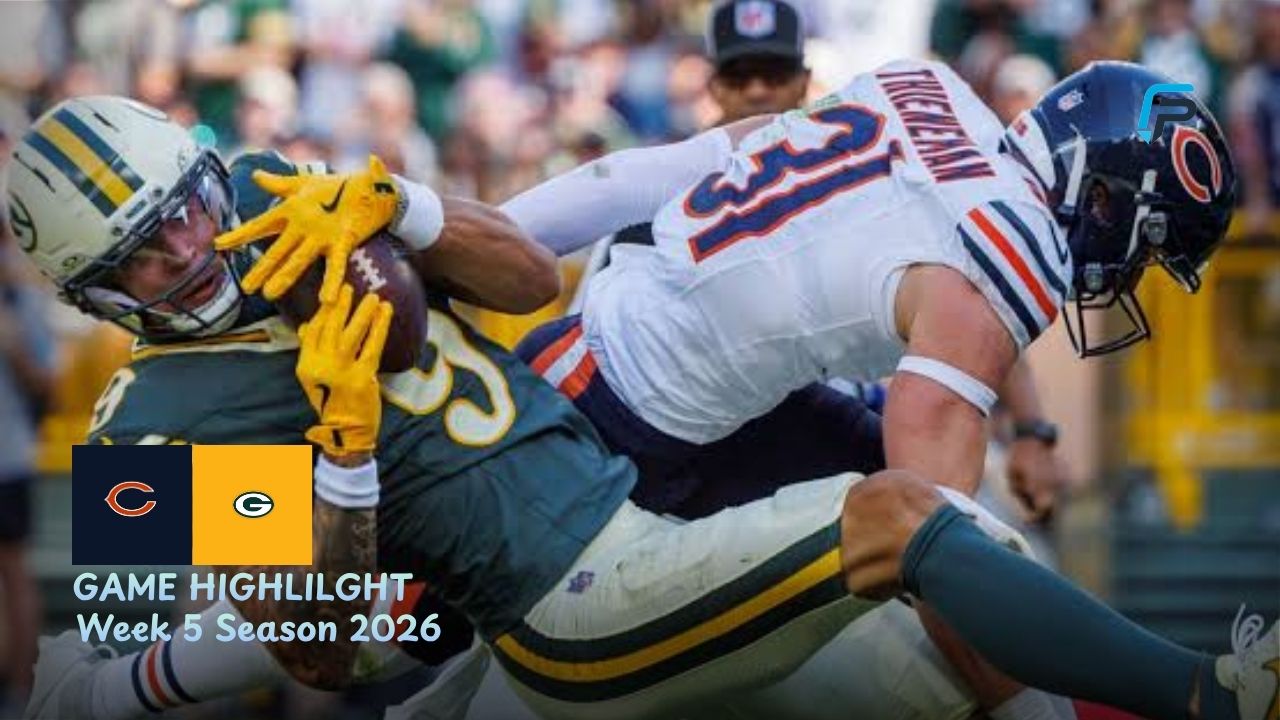
The Green Bay Packers delivered a dominant performance against the Chicago Bears on October 11, 2026, winning 31–7 at Lambeau Field. Quarterback Jordan Love led the Packers’ passing attack with 367 yards and two touchdown passes, while wide receiver Christian Watson turned those opportunities into a major difference-maker. Chicago struggled to protect the football, committing five turnovers in a difficult divisional matchup.
The Week 5 contest featured big plays, defensive takeaways, and a second-half collapse by the Bears. Chicago scored its only touchdown before halftime, but Green Bay shut out the visitors over the final two quarters and extended its lead. The Packers’ offense made the most of its opportunities, while the defense repeatedly stopped Chicago from building momentum. Here is a detailed breakdown of the final score, player statistics, key plays, and the performances that shaped the game.
Quarter-by-Quarter Score
| Quarter | Chicago Bears | Green Bay Packers |
|---|---|---|
| First | 0 | 7 |
| Second | 7 | 7 |
| Third | 0 | 9 |
| Fourth | 0 | 8 |
| Final | 7 | 31 |
The Packers scored in every quarter, building a 14–7 halftime lead before adding 17 unanswered points in the second half. Green Bay’s two third-quarter scoring plays created separation, and MarShawn Lloyd’s fourth-quarter touchdown helped seal the win.
Jordan Love Leads Green Bay’s Passing Attack
Jordan Love was the standout quarterback of the afternoon. He completed 25 of 31 passes for 367 yards and two touchdowns without throwing an interception. His completion rate was approximately 80.6%, and his 137.5 passer rating reflected how efficiently he moved the ball through the air. Love repeatedly found receivers in space and connected on deep throws that stretched Chicago’s defense.
Love’s connection with Christian Watson proved especially important. Both of the quarterback’s touchdown passes went to Watson, including a 42-yard score in the first quarter and a 53-yard touchdown in the third. The longer strike helped Green Bay start pulling away after halftime. Love also spread the ball around, giving Matthew Golden and Tucker Kraft opportunities to make significant gains.
Jordan Love’s passing stats
| Statistic | Total |
|---|---|
| Completions | 25 |
| Pass attempts | 31 |
| Completion rate | 80.6% |
| Passing yards | 367 |
| Passing touchdowns | 2 |
| Interceptions | 0 |
| Passer rating | 137.5 |
| Longest completion | 53 yards |
Love’s performance gave Green Bay consistent production without putting the ball in danger. Chicago’s defense failed to intercept him, while the Packers’ offense turned his accuracy and downfield passing into a convincing divisional win.
Tyson Bagent and Case Keenum: Bears Quarterback Stats
Chicago used two quarterbacks during the game, but neither could match Love’s production. Tyson Bagent completed 12 of 21 passes for 87 yards and threw two interceptions. He was replaced by veteran Case Keenum at the start of the fourth quarter as the Bears looked for a spark. Keenum completed 11 of 19 passes for 108 yards, but he also threw an interception and lost a fumble.
Together, the quarterbacks completed 23 of 40 passes for 195 yards, with no passing touchdowns and three interceptions. That limited production made it difficult for Chicago to respond after Green Bay extended its lead. The Bears’ passing game struggled to create explosive plays, and the turnovers repeatedly ended drives before the offense could build pressure on the Packers.
| Bears quarterback | Comp/Att | Passing yards | TD | INT |
|---|---|---|---|---|
| Tyson Bagent | 12/21 | 87 | 0 | 2 |
| Case Keenum | 11/19 | 108 | 0 | 1 |
| Combined | 23/40 | 195 | 0 | 3 |
The key difference was not just passing yardage. Green Bay avoided interceptions, while Chicago gave the Packers three through the air. That gap in ball security shaped the game and left the Bears chasing a deficit for much of the second half.
Christian Watson Delivers Two Touchdown Receptions
Christian Watson was Green Bay’s leading receiver and one of the game’s most influential players. He caught six passes for 143 yards and two touchdowns, averaging 23.8 yards per reception. His 42-yard touchdown opened the scoring, and his 53-yard touchdown in the third quarter gave the Packers a decisive boost. Both plays showed how quickly Green Bay could turn a completed pass into points.
Matthew Golden also had a strong afternoon, catching six passes for 123 yards. His longest reception covered 50 yards and helped the Packers maintain their downfield threat. Tight end Tucker Kraft added five receptions for 64 yards, including a 46-yard catch. With three receivers making significant contributions, Chicago had trouble containing Green Bay’s passing attack.
Packers receiving leaders
| Receiver | Receptions | Yards | Touchdowns |
|---|---|---|---|
| Christian Watson | 6 | 143 | 2 |
| Matthew Golden | 6 | 123 | 0 |
| Tucker Kraft | 5 | 64 | 0 |
| Bo Melton | 3 | 20 | 0 |
| Pierre Strong | 3 | 11 | 0 |
Watson’s two touchdowns made him the clear scoring leader among Green Bay’s receivers. Golden’s yardage and Kraft’s contributions added balance, preventing the Bears from focusing their coverage on one player.
D’Andre Swift Scores Chicago’s Only Touchdown
D’Andre Swift provided Chicago’s only touchdown and its most productive rushing performance. He carried the ball nine times for 43 yards and scored on a one-yard run late in the second quarter. The touchdown completed a 16-play, 78-yard drive that brought the Bears within seven points at halftime. For a brief period, the long possession gave Chicago a chance to regroup and make the contest more competitive.
Swift also caught four passes for 30 yards, giving him 73 yards from scrimmage. Luther Burden III led Chicago’s receivers with four catches for 47 yards, while Rome Odunze added three receptions for 40 yards. Roschon Johnson caught five passes for 34 yards, but the Bears could not turn those individual contributions into more scoring drives.
Bears offensive leaders
| Player | Performance |
|---|---|
| D’Andre Swift | 9 carries, 43 rushing yards, 1 TD |
| Luther Burden III | 4 catches, 47 receiving yards |
| Rome Odunze | 3 catches, 40 receiving yards |
| Roschon Johnson | 5 catches, 34 receiving yards |
| Colston Loveland | 2 catches, 19 receiving yards |
MarShawn Lloyd Scores Twice on the Ground
MarShawn Lloyd supplied the Packers’ rushing touchdowns, finishing with 10 carries for 31 yards and two scores. His first touchdown came on a seven-yard run in the second quarter, extending Green Bay’s lead to 14–0. He scored again from four yards out in the fourth quarter, completing a drive that pushed the score to 31–7 after a successful two-point conversion.
Green Bay did not need a huge rushing total to win. The Packers gained 70 yards on the ground as a team, but their passing game created the biggest gains. Lloyd’s ability to finish scoring opportunities helped the offense turn its advantage into points. Kaleb Johnson added 26 rushing yards on seven carries, while Pierre Strong recorded seven yards on five attempts.
Packers Defense Creates Five Bears Turnovers
Green Bay’s defense played a major role in the victory by taking the ball away and limiting Chicago’s scoring chances. Safety Xavier McKinney intercepted Bagent twice, while Ty’Ron Hopper recorded another interception after Keenum entered the game. Hopper’s takeaway came near the goal line and stopped a Bears drive that could have reduced the deficit.
Chicago’s problems continued with lost fumbles. Rome Odunze lost a fumble, and Keenum also lost possession in the fourth quarter. The Bears finished with five turnovers overall, while Green Bay committed none. The Packers scored 15 points off Chicago’s mistakes, making ball security one of the biggest factors behind the result.
The defense’s performance was especially important because it supported the offense when Green Bay needed to protect its lead. Rather than allowing Chicago to build momentum, the Packers repeatedly ended possessions and returned the ball to Love. Those extra opportunities helped Green Bay control the second half.
Team Statistics: Chicago Bears vs Green Bay Packers
The team numbers show how Green Bay combined an efficient passing attack with a strong defensive performance. The Packers finished with 437 total yards, while Chicago managed 276. The Bears gained 195 passing yards and 81 rushing yards, but their five turnovers outweighed much of that production.
| Team statistic | Bears | Packers |
|---|---|---|
| Total yards | 276 | 437 |
| Passing yards | 195 | 367 |
| Rushing yards | 81 | 70 |
| First downs | 17 | 18 |
| Third-down efficiency | 4/14 | 4/12 |
| Turnovers | 5 | 0 |
| Penalties | 3 for 20 yards | 4 for 25 yards |
| Time of possession | 29:36 | 30:24 |
Chicago actually gained more rushing yards than Green Bay, but the Packers’ passing advantage was substantial. Green Bay averaged nearly 11.8 yards per pass attempt, compared with 4.9 yards per attempt for the Bears. That difference helped the Packers move the ball downfield faster and turn fewer offensive possessions into a bigger scoring margin.
Key Scoring Plays That Decided the Game
Green Bay’s first touchdown arrived in the opening quarter when Love connected with Watson on a 42-yard pass. Lloyd then added a seven-yard rushing touchdown early in the second quarter to make it 14–0. Chicago answered with Swift’s one-yard touchdown run just before halftime, cutting the score to 14–7 and keeping the game within reach.
The second half belonged to Green Bay. Love and Watson connected again on a 53-yard touchdown pass early in the third quarter. A 35-yard field goal from Trey Smack extended the lead to 23–7, and Lloyd’s four-yard touchdown run in the fourth quarter made the final score 31–7. Green Bay outscored Chicago 17–0 after halftime and never allowed the Bears to score again.
What the Week 5 Result Means for Both Teams
The victory gave Green Bay a much-needed divisional win and brought the Packers level with Chicago at 3–2, according to the game recap. Winning at Lambeau Field also helped Green Bay regain momentum after a difficult start to the season. The team’s passing production and defensive takeaways showed what it could achieve when both units performed well together.
For Chicago, the defeat highlighted the importance of protecting the football and finding more consistency at quarterback. The Bears had some positive moments, especially during Swift’s long touchdown drive, but five turnovers made it extremely difficult to compete. The offense will need better ball security and more effective passing production to avoid similar problems in future games.
Conclusion
The Chicago Bears vs Green Bay Packers Match Player Stats from Week 5 tell the story of a convincing 31–7 Green Bay victory. Jordan Love threw for 367 yards and two touchdowns, Christian Watson caught both scoring passes, and MarShawn Lloyd added two rushing touchdowns. The Packers’ defense also made a major difference by recording three interceptions and helping force five Chicago turnovers.
Swift’s touchdown was the Bears’ only scoring play, and Chicago failed to score after halftime. Green Bay’s explosive passing, disciplined ball security, and timely defensive plays proved decisive. For readers reviewing the October 11 matchup, the biggest takeaway is clear: the Packers won through a combination of efficient offense and a defense that consistently punished Chicago’s mistakes.
Stay More Update FEATURE POSTS