
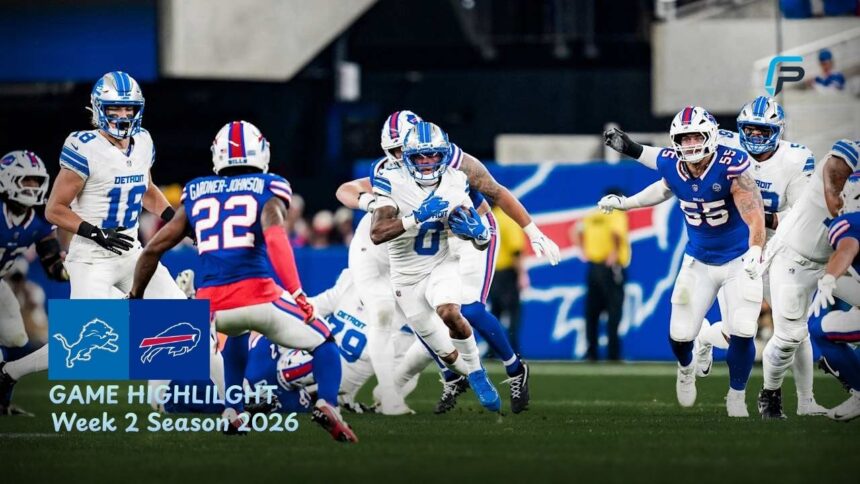
The Buffalo Bills defeated the Detroit Lions 41–31 on Thursday, September 17, 2026, in the first regular-season game at the new Highmark Stadium. Buffalo took control early and built a 21–0 advantage before Detroit began its comeback. The Bills ultimately held on behind a five-touchdown performance from Josh Allen.
Match Overview
The Week 2 matchup featured two high-powered offenses, but Buffalo created the biggest early separation. The Bills scored on five of their first six possessions and entered halftime with a 27–10 lead. Detroit responded after the break, but Buffalo continued to answer key scoring drives and protected its advantage.
Jared Goff kept Detroit competitive with 327 passing yards and four touchdown passes. Amon-Ra St. Brown also produced a major receiving performance, finishing with nine catches for 142 yards and two touchdowns. However, Buffalo’s balanced attack produced 446 total yards compared with Detroit’s 355.
Final Score Table
| Team | Q1 | Q2 | Q3 | Q4 | Final |
|---|---|---|---|---|---|
| Detroit Lions | 0 | 10 | 7 | 14 | 31 |
| Buffalo Bills | 14 | 13 | 7 | 7 | 41 |
Match Details
| Detail | Information |
|---|---|
| Match | Detroit Lions vs Buffalo Bills |
| Date | September 17, 2026 |
| Week | NFL Week 2 |
| Venue | Highmark Stadium |
| Final Score | Bills 41, Lions 31 |
| Bills Record | 2–0 |
| Lions Record | 1–1 |
| Game Type | Regular Season |
| Winner | Buffalo Bills |

The game marked the first regular-season contest at Buffalo’s new Highmark Stadium. The Bills celebrated the occasion with a 41–31 victory and moved to 2–0, while Detroit dropped to 1–1.
Josh Allen Leads Buffalo’s Offense
Josh Allen was the central figure in Buffalo’s victory. He completed 20 of 31 passes for 248 yards and three touchdowns without an interception. Allen also rushed 14 times for 69 yards and two touchdowns, giving him five total touchdowns on the night.
Allen repeatedly extended Buffalo’s advantage whenever Detroit threatened to close the gap. His rushing ability added another dimension to the Bills’ offense, while his passing touchdowns helped Buffalo establish its early lead. The performance made Allen one of the game’s biggest statistical contributors.
Jared Goff’s Strong Passing Performance
Jared Goff produced an impressive statistical line despite the Lions’ defeat. He completed 26 of 38 attempts for 327 yards and four touchdowns without throwing an interception. Goff kept attacking throughout the game and helped Detroit score 21 points after halftime.
Goff’s fourth touchdown arrived late in the fourth quarter when he connected with Amon-Ra St. Brown for a 27-yard score. That play cut Buffalo’s lead but came with only 1:48 remaining, leaving Detroit too little time to complete another possession.
Player Stats Table
| Player | Team | Key Stats |
|---|---|---|
| Josh Allen | Bills | 20/31, 248 pass yds, 3 pass TD; 69 rush yds, 2 rush TD |
| Jared Goff | Lions | 26/38, 327 pass yds, 4 pass TD |
| James Cook | Bills | 21 rushes, 135 yds, 1 TD |
| Amon-Ra St. Brown | Lions | 9 receptions, 142 yds, 2 TD |
| Dalton Kincaid | Bills | 7 receptions, 95 yds, 1 TD |
| Jahmyr Gibbs | Lions | 16 rushes, 52 yds; 6 receptions, 61 yds, 1 TD |
| Sam LaPorta | Lions | 6 receptions, 52 yds, 1 TD |
| Joshua Palmer | Bills | 1 reception, 43 yds, 1 TD |
The statistics show how both teams relied heavily on their quarterbacks and top offensive weapons. Buffalo gained major production from James Cook on the ground, while Detroit leaned on Goff’s passing and St. Brown’s receiving ability.
Passing Statistics
| Quarterback | C/ATT | Pass Yards | TD | INT |
|---|---|---|---|---|
| Jared Goff, DET | 26/38 | 327 | 4 | 0 |
| Josh Allen, BUF | 20/31 | 248 | 3 | 0 |
Both starting quarterbacks avoided interceptions, making the difference more about efficiency, rushing production, and early scoring opportunities. Goff produced more passing yards, but Allen added two rushing touchdowns to his three touchdown passes.
Buffalo’s defense also pressured Goff throughout the game, recording four sacks. That pressure helped the Bills maintain control even while Detroit’s passing game continued to generate significant yardage.
Rushing Statistics
| Player | Team | Carries | Rush Yards | TD |
|---|---|---|---|---|
| James Cook | BUF | 21 | 135 | 1 |
| Josh Allen | BUF | 14 | 69 | 2 |
| Jahmyr Gibbs | DET | 16 | 52 | 0 |
| Sione Vaki | DET | 1 | 7 | 0 |
| Jared Goff | DET | 3 | 7 | 0 |
James Cook gave Buffalo a strong rushing foundation with 135 yards on 21 carries. His 35-yard run was his longest of the game, and his late one-yard touchdown pushed Buffalo’s lead back to 41–24 with 2:50 remaining.
Allen’s 69 rushing yards and two touchdowns added another major advantage for Buffalo. Detroit’s Gibbs led the Lions in rushing with 52 yards, but the Bills generated considerably more production on the ground during the game.
Receiving Statistics
| Receiver | Team | Receptions | Yards | TD |
|---|---|---|---|---|
| Amon-Ra St. Brown | DET | 9 | 142 | 2 |
| Dalton Kincaid | BUF | 7 | 95 | 1 |
| Jahmyr Gibbs | DET | 6 | 61 | 1 |
| Keon Coleman | BUF | 6 | 63 | 0 |
| Sam LaPorta | DET | 6 | 52 | 1 |
| Joshua Palmer | BUF | 1 | 43 | 1 |
St. Brown was Detroit’s leading receiver and consistently gave Goff a reliable target. His two touchdowns helped the Lions stay within striking distance, including his late 27-yard touchdown that brought Detroit to 31 points.
Kincaid led Buffalo in receptions with seven for 95 yards and a touchdown. Joshua Palmer provided one of the game’s biggest individual plays with a 43-yard touchdown reception during Buffalo’s fast start.
Team Statistics
| Statistic | Lions | Bills |
|---|---|---|
| Total Yards | 355 | 446 |
| Passing Yards | 327 | 248 |
| Rushing Yards | 28 | 198 |
| Total Plays | 62 | 69 |
| Yards per Play | 5.7 | 6.5 |
| Time of Possession | 26:15 | 33:45 |
| Turnovers | 0 | 0 |
| Penalties | 10 | 5 |
| Penalty Yards | 58 | 46 |
The team statistics highlight Buffalo’s balance. Detroit actually produced more passing yards, but the Bills created a major advantage on the ground and finished with 446 total yards. Buffalo also held the ball for 33:45, more than seven minutes longer than Detroit.
Neither team committed a turnover, so field position, red-zone execution, and Buffalo’s early offensive burst became especially important. The Bills went five-for-five in the red zone, turning every red-zone opportunity into a touchdown.
Important Game Moments
Buffalo opened the game with two quick touchdowns. Allen scored on a one-yard run before connecting with Palmer for a 43-yard touchdown. The Bills then extended their lead when Allen found Dawson Knox for a one-yard score, creating a 21–0 advantage early in the second quarter.
Detroit finally answered through Gibbs, who caught an 11-yard touchdown pass from Goff. Kincaid responded with a 16-yard touchdown reception, keeping Buffalo comfortably ahead. Detroit continued fighting after halftime, but Allen’s third-quarter rushing touchdown and Cook’s late score helped Buffalo maintain control.
Turning Point of the Game
The biggest turning point came during Buffalo’s explosive first half. The Bills scored touchdowns on five of their first six possessions, allowing them to build a substantial cushion before Detroit’s offense found its rhythm. That early advantage gave Buffalo room to absorb Detroit’s second-half comeback attempts.
Detroit’s fourth-quarter push briefly made the game more competitive. LaPorta’s touchdown brought the Lions within 10 points, but Buffalo responded with a long drive that ended with Cook’s one-yard touchdown. That score restored a 17-point lead and effectively ended Detroit’s comeback hopes.
Final Match Summary
The Detroit Lions vs Buffalo Bills matchup delivered an offensive-heavy Week 2 contest, with Buffalo winning 41–31. Allen finished with five total touchdowns, Cook ran for 135 yards and a score, and Kincaid added 95 receiving yards and a touchdown. Buffalo’s 446 total yards and strong red-zone execution proved decisive.
Detroit still produced several standout individual performances. Goff threw for 327 yards and four touchdowns, while St. Brown recorded nine catches for 142 yards and two scores. However, the Lions could not overcome Buffalo’s fast start and balanced offense. The Bills moved to 2–0, while Detroit entered the rest of the season at 1–1.
Stay More Update FEATURE POSTS