
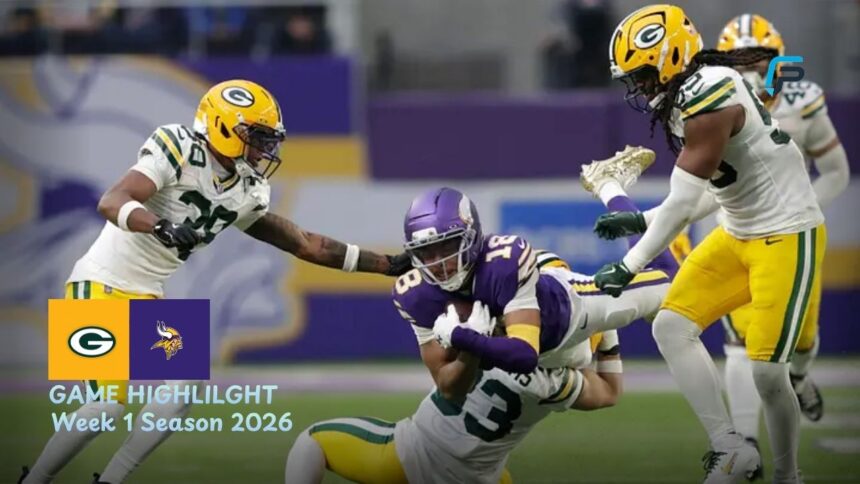
The Minnesota Vikings produced one of the biggest comebacks of NFL Week 1, defeating the Green Bay Packers 39–22 on September 13, 2026, at U.S. Bank Stadium. Green Bay controlled much of the first three quarters and led 22–10 late in the third period. However, Minnesota completely changed the game in the final quarter, scoring 22 unanswered points to finish with a 17-point victory. The result gave Minnesota a 1–0 start, while Green Bay fell to 0–1.
The Green Bay Packers vs Minnesota Vikings match player stats also tell the story of two contrasting quarterback performances. Jordan Love threw for 387 yards and two touchdowns, with both scores going to Christian Watson. For Minnesota, Carson Wentz stepped in after Kyler Murray left with a concussion and threw three touchdown passes. Justin Jefferson caught eight passes for 92 yards and two touchdowns, becoming a major part of Minnesota’s stunning second-half comeback.
Final Score and Match Details
Green Bay started the game strongly and built a 19–10 halftime advantage. Jordan Love connected with Christian Watson on an 81-yard touchdown during the opening quarter, while Trey Smack added field goals from 59 and 43 yards. Minnesota answered through Will Reichard’s field goal and Carson Wentz’s 39-yard touchdown pass to Justin Jefferson, but the Vikings entered halftime still trailing.
The Packers extended their lead to 22–10 early in the third quarter with another Smack field goal. Minnesota then began its comeback with Wentz’s 16-yard touchdown pass to T.J. Hockenson. The Vikings scored 29 consecutive points after falling behind 22–10, including four straight touchdown drives in the second half.
| Match Detail | Information |
|---|---|
| Teams | Green Bay Packers vs Minnesota Vikings |
| Date | September 13, 2026 |
| Venue | U.S. Bank Stadium, Minneapolis |
| Final Score | Vikings 39, Packers 22 |
| Week | NFL Week 1 |
| Packers Record | 0–1 |
| Vikings Record | 1–0 |
Team Statistics

Green Bay actually finished with more total yardage than Minnesota, producing 419 yards compared with the Vikings’ 239. The Packers averaged 6.3 yards per play and ran 67 plays, while Minnesota recorded 61 plays at 3.9 yards per play. Despite the yardage advantage, Green Bay could not convert its offensive production into enough points during the decisive stages.
Minnesota’s biggest statistical advantages came from efficiency and avoiding mistakes at critical moments. The Vikings committed only one turnover, while Green Bay turned the ball over twice. The Packers also committed 12 penalties for 98 yards, compared with only three penalties for 15 yards by Minnesota. Those differences helped the Vikings overcome their lower total yardage.
| Team Stat | Packers | Vikings |
|---|---|---|
| Total Yards | 419 | 239 |
| Plays | 67 | 61 |
| Yards per Play | 6.3 | 3.9 |
| Rushing Attempts | 21 | 34 |
| Turnovers | 2 | 1 |
| Possession | 27:02 | 32:58 |
| Penalties | 12 | 3 |
| Penalty Yards | 98 | 15 |
| First Downs | 19 | 19 |
Jordan Love’s Strong Statistical Performance
Jordan Love produced one of the best statistical passing performances of Week 1 despite Green Bay’s loss. He completed 21 of 42 passes for 387 yards and two touchdowns. His two scoring passes went to Christian Watson, including an explosive 81-yard touchdown during the first quarter. Love also threw one interception and was sacked four times for 34 yards.
Love’s passing numbers showed that Green Bay could move the football through the air. The bigger issue was the team’s inability to sustain that production after halftime. Minnesota increased its pressure, forced turnovers, and made the Packers’ offense less effective during the final quarter. Love’s individual numbers remained impressive, but they were not enough to prevent the comeback.
| Quarterback | Comp/Att | Pass Yards | TD | INT | Sacks |
|---|---|---|---|---|---|
| Jordan Love | 21/42 | 387 | 2 | 1 | 4 |
| Carson Wentz | 12/19 | 133 | 3 | 0 | 3 |
| Kyler Murray | 3/5 | 18 | 0 | 1 | 0 |
Carson Wentz Leads Minnesota Comeback
Carson Wentz became the central figure in Minnesota’s comeback after Kyler Murray left the game with a concussion early in the first quarter. Wentz completed 12 of 19 passes for 133 yards and three touchdowns without an interception. His 123.5 passer rating reflected how efficiently he operated once the Vikings found their rhythm.
Wentz’s biggest contribution came after Minnesota trailed 22–10. He led four consecutive touchdown drives and repeatedly found Jefferson and Hockenson in important situations. His final touchdown pass to Jefferson with 3:55 remaining completed the scoring and gave Minnesota a 39–22 advantage. The veteran quarterback turned an early setback into one of Week 1’s most memorable performances.
Christian Watson Dominates for Green Bay
Christian Watson was easily Green Bay’s biggest offensive star. He caught six of eight targets for 147 yards and two touchdowns. His first score was an 81-yard reception from Love, while his second came on a two-yard touchdown shortly before halftime. Watson averaged 24.5 yards per reception and provided Green Bay with an explosive threat throughout the afternoon.
Matthew Golden also delivered a productive performance in his first Week 1 game with the Packers. He caught six passes for 95 yards, including a 42-yard reception. Tucker Kraft added three catches for 65 yards, while Jonnu Smith contributed two receptions for 50 yards. Green Bay’s passing attack generated plenty of yardage, but the offense struggled to finish the game.
| Receiver | Team | Receptions | Yards | TD |
|---|---|---|---|---|
| Christian Watson | GB | 6 | 147 | 2 |
| Matthew Golden | GB | 6 | 95 | 0 |
| Tucker Kraft | GB | 3 | 65 | 0 |
| Jonnu Smith | GB | 2 | 50 | 0 |
| Justin Jefferson | MIN | 8 | 92 | 2 |
| T.J. Hockenson | MIN | 4 | 36 | 1 |
Justin Jefferson Powers Vikings Offense
Justin Jefferson became Minnesota’s most important offensive weapon during the comeback. He finished with eight receptions for 92 yards and two touchdowns. His first touchdown covered 39 yards in the second quarter, while his second came on a nine-yard pass from Wentz in the fourth quarter. Jefferson also caught the successful two-point conversion after Aaron Jones’ touchdown.
T.J. Hockenson provided another key contribution with four receptions for 36 yards and a 16-yard touchdown. His score reduced Green Bay’s lead to 22–17 early in the second half and helped spark Minnesota’s comeback. The Vikings did not need huge receiving numbers because their offense became extremely efficient when the game entered its final stages.
Rushing Performances
Minnesota’s ground game was led by Jordan Mason, who carried the ball 15 times for 59 yards and one touchdown. Aaron Jones Sr. added 40 yards on 12 carries and scored another touchdown against his former team. Their combined production helped Minnesota control the clock during the fourth quarter.
Green Bay struggled to establish a consistent running game. MarShawn Lloyd led the Packers with 37 yards on 13 carries, while Chris Brooks added 29 yards on seven attempts. Jordan Love finished with one rushing attempt for no gain. The lack of a strong ground attack made the Packers increasingly dependent on Love’s passing during the comeback attempt.
| Rusher | Team | Carries | Yards | TD |
|---|---|---|---|---|
| MarShawn Lloyd | GB | 13 | 37 | 0 |
| Chris Brooks | GB | 7 | 29 | 0 |
| Jordan Mason | MIN | 15 | 59 | 1 |
| Aaron Jones Sr. | MIN | 12 | 40 | 1 |
| Kyler Murray | MIN | 2 | 9 | 0 |
| Carson Wentz | MIN | 5 | -1 | 0 |
Key Scoring Moments
Green Bay opened the game with Trey Smack’s 59-yard field goal before Love connected with Watson for an 81-yard touchdown. Smack added another 43-yard field goal, giving the Packers a 12–3 advantage. Minnesota then responded when Wentz found Jefferson for a 39-yard touchdown, but Green Bay answered with Watson’s two-yard touchdown reception to take a 19–10 halftime lead.
Smack’s 26-yard field goal pushed Green Bay ahead 22–10 in the third quarter. Minnesota responded with Wentz’s touchdown pass to Hockenson. The fourth quarter completely belonged to the Vikings as Jones scored on a three-yard run, Mason added a one-yard touchdown, and Jefferson caught his second touchdown. Minnesota’s final quarter produced 22 points without an answer from Green Bay.
Kyler Murray’s Early Exit
Kyler Murray’s Vikings debut lasted only a short time. The quarterback completed three of five passes for 18 yards and threw one interception before leaving after suffering a concussion while scrambling. The injury forced Minnesota to turn to Wentz much earlier than expected.
Wentz handled the unexpected responsibility exceptionally well. Rather than allowing Murray’s departure to derail the Vikings, he settled into the offense and eventually produced three touchdown passes. His performance was particularly important because Minnesota entered the second half trailing by nine points and later needed to overcome a 12-point deficit.
Turning Point of the Game
The biggest turning point arrived after Green Bay moved ahead 22–10 early in the third quarter. Minnesota’s offense suddenly became more efficient, while the Vikings’ defense began putting pressure on Love. The Vikings scored their first touchdown of the comeback when Wentz found Hockenson, then carried that momentum into a dominant fourth quarter.
Green Bay’s turnovers and penalties also became increasingly costly. The Packers finished with 12 penalties for 98 yards and two turnovers. Minnesota, meanwhile, committed only three penalties. The Vikings took advantage of favorable situations and finished the game with 29 consecutive points after trailing 22–10, turning a potential Green Bay victory into a convincing home win.
Final Match Summary
The Minnesota Vikings defeated the Green Bay Packers 39–22 after overcoming a 22–10 deficit. Carson Wentz completed 12 of 19 passes for 133 yards and three touchdowns, while Justin Jefferson caught eight passes for 92 yards and two scores. Jordan Mason and Aaron Jones Sr. each added a rushing touchdown. Minnesota’s defense also forced two turnovers during the comeback, helping the Vikings finish the game with 29 unanswered points.
Green Bay received outstanding performances from Jordan Love and Christian Watson, but the Packers could not protect their lead. Love threw for 387 yards and two touchdowns, while Watson produced 147 receiving yards and two scores. The Packers’ 419 total yards were not enough because of their second-half collapse, turnovers, and penalties. Minnesota’s comeback gave the Vikings a 1–0 start and left Green Bay searching for answers heading into Week 2.
Stay More Update FEATURE POSTS