

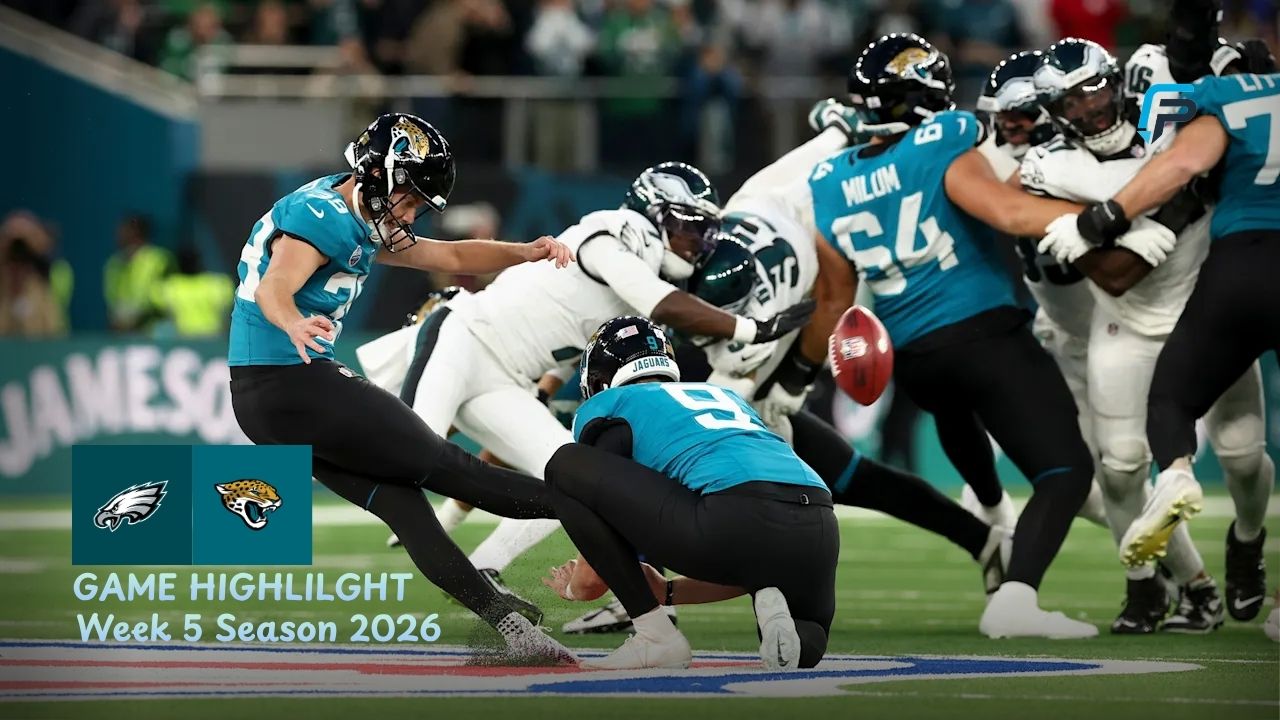
The Philadelphia Eagles and Jacksonville Jaguars delivered a dramatic finish in their Week 5 NFL matchup on October 11, 2026. Jacksonville earned a 19–17 victory at Tottenham Hotspur Stadium in London after kicker Cam Little converted a 57-yard field goal on the final play. The Eagles briefly moved ahead with only eight seconds remaining, but a long kickoff return gave Jacksonville one last chance to win.
Jacksonville’s passing offense and ball control helped the team overcome Philadelphia’s second-quarter surge. Trevor Lawrence threw for 331 yards and two touchdowns, while Parker Washington caught six passes for 124 yards and two scores. Philadelphia quarterback Jalen Hurts passed for 220 yards and one touchdown, but the Eagles managed only 22 rushing yards.
Final Score
| Team | Q1 | Q2 | Q3 | Q4 | Final |
|---|---|---|---|---|---|
| Philadelphia Eagles | 0 | 14 | 0 | 3 | 17 |
| Jacksonville Jaguars | 7 | 0 | 3 | 9 | 19 |
Jacksonville opened the scoring with a 51-yard touchdown pass from Lawrence to Washington. Philadelphia responded with two touchdowns in the second quarter, taking a 14–7 halftime lead. The Jaguars added a third-quarter field goal before Washington caught another touchdown pass late in the fourth quarter. Jacksonville’s failed extra point left the team trailing 17–14, setting up the dramatic final moments.
Jake Elliott gave Philadelphia a 17–16 lead with a 48-yard field goal and eight seconds remaining. Ameer Abdullah then returned the kickoff 53 yards, placing Jacksonville in position for a final attempt. Little connected from 57 yards as time expired, completing the Jaguars’ comeback and handing Philadelphia another difficult loss.
Match Details
| Match Detail | Information |
|---|---|
| Matchup | Philadelphia Eagles vs Jacksonville Jaguars |
| Date | October 11, 2026 |
| NFL Week | Week 5 |
| Venue | Tottenham Hotspur Stadium |
| Location | London, United Kingdom |
| Final Score | Jaguars 19–17 Eagles |
| Jaguars Record | 4–1 |
| Eagles Record | 2–3 |
The game took place at Tottenham Hotspur Stadium in London as part of the NFL’s international schedule. Jacksonville entered Week 5 looking to extend its winning run, while Philadelphia hoped to recover after consecutive defeats. The result moved the Jaguars to 4–1 and dropped the Eagles to 2–3, giving Jacksonville a stronger position early in the season.
The contest featured two different offensive approaches. Philadelphia found its best scoring rhythm in the second quarter, but Jacksonville produced more total yardage and controlled possession for most of the game. The final kickoff return and long field goal ultimately decided a matchup that remained close despite Jacksonville’s statistical advantage.
Explore Tennessee Titans vs Baltimore Ravens Match Player Stats Full Week 4 Breakdown
Team Statistics Breakdown
Jacksonville finished with 408 total net yards, compared with Philadelphia’s 232. The Jaguars also ran more plays and held possession for more than 35 minutes. Philadelphia struggled to move the ball consistently on the ground, finishing with only 22 rushing yards. Those numbers limited the Eagles’ ability to maintain long drives and protect their second-quarter advantage.
| Team Statistic | Eagles | Jaguars |
|---|---|---|
| Total Net Yards | 232 | 408 |
| Total Plays | 59 | 68 |
| Yards per Play | 3.9 | 6.0 |
| Net Passing Yards | 210 | 306 |
| Rushing Yards | 22 | 102 |
| Turnovers | 0 | 1 |
| Penalties | 7 | 13 |
| Penalty Yards | 43 | 100 |
| Time of Possession | 24:58 | 35:02 |
Philadelphia committed fewer penalties and did not turn the ball over, but those advantages were not enough to secure the win. Jacksonville’s 6.0 yards per play showed its greater offensive efficiency. The Jaguars also held the ball for over ten minutes longer, helping them generate more opportunities and keep pressure on Philadelphia’s defense.
Quarterback Performance
Trevor Lawrence delivered Jacksonville’s leading offensive performance, completing 24 of 39 passes for 331 yards, two touchdowns, and one interception. His connection with Washington created two of the game’s most important scoring plays. Lawrence continued to attack downfield even when Philadelphia moved ahead, and his late touchdown pass helped give Jacksonville a final opportunity to win.
| Quarterback | Team | Completions/Attempts | Passing Yards | TD | INT |
|---|---|---|---|---|---|
| Trevor Lawrence | Jaguars | 24/39 | 331 | 2 | 1 |
| Jalen Hurts | Eagles | 21/40 | 220 | 1 | 0 |
Hurts completed 21 of 40 passes for 220 yards and one touchdown without an interception. His 62-yard touchdown connection with Darius Cooper helped Philadelphia take control before halftime. However, Jacksonville limited the Eagles’ overall production, and Hurts received little support from the rushing game. Philadelphia could not produce another touchdown after its two second-quarter scores.
Rushing Statistics
Jacksonville gained 102 rushing yards, led by Bhayshul Tuten. He carried the ball 22 times for 72 yards and helped the Jaguars sustain drives. Lawrence added 25 yards on three carries, providing another way to move the offense forward. Although Jacksonville did not score a rushing touchdown, its ground game helped the team manage possession and keep Philadelphia’s defense working.
| Player | Team | Carries | Rushing Yards | Long | TD |
|---|---|---|---|---|---|
| Bhayshul Tuten | Jaguars | 22 | 72 | 13 | 0 |
| Trevor Lawrence | Jaguars | 3 | 25 | 16 | 0 |
| Chris Rodriguez Jr. | Jaguars | 2 | 5 | 5 | 0 |
| Dameon Pierce | Eagles | 11 | 14 | 6 | 0 |
| Will Shipley | Eagles | 5 | 6 | 3 | 1 |
| Jalen Hurts | Eagles | 2 | 2 | 2 | 0 |
Philadelphia’s rushing attack produced only 22 yards across the team. Will Shipley scored on a two-yard run in the second quarter, but the Eagles found little room for additional gains. Dameon Pierce managed 14 yards on 11 carries, while Hurts recorded just two rushing yards. That limited production made it harder for Philadelphia to balance its passing offense.
Explore New York Jets vs Chicago Bears Match Player Stats and Key Performers
Receiving Statistics
Parker Washington was Jacksonville’s biggest receiving threat. He caught six passes for 124 yards and two touchdowns, including a 51-yard score in the first quarter and a 27-yard touchdown late in the fourth. His ability to create explosive plays gave the Jaguars a scoring advantage and helped Lawrence deliver one of the game’s most productive passing performances.
| Player | Team | Receptions | Receiving Yards | Long | TD |
|---|---|---|---|---|---|
| Parker Washington | Jaguars | 6 | 124 | 51 | 2 |
| Brenton Strange | Jaguars | 7 | 68 | 27 | 0 |
| Josh Cameron | Jaguars | 3 | 43 | 32 | 0 |
| Jakobi Meyers | Jaguars | 2 | 37 | 19 | 0 |
| Bhayshul Tuten | Jaguars | 2 | 24 | 18 | 0 |
| Darius Cooper | Eagles | 2 | 71 | 62 | 1 |
| Dontayvion Wicks | Eagles | 5 | 63 | 19 | 0 |
| Makai Lemon | Eagles | 5 | 43 | 18 | 0 |
| Dallas Goedert | Eagles | 6 | 38 | 17 | 0 |
Darius Cooper provided Philadelphia’s most explosive receiving play, finishing with 71 yards and a touchdown on two catches. His 62-yard scoring reception helped the Eagles take a seven-point halftime lead. Wicks added 63 yards, while Goedert caught six passes. Despite these contributions, Philadelphia could not match Washington’s two touchdowns or Jacksonville’s overall passing production.
Key Player Performances
Washington’s two touchdown receptions made him the game’s most decisive offensive player. His early score established Jacksonville’s presence, and his late touchdown put the Jaguars in front during the fourth quarter. Lawrence supported that performance with 331 passing yards, consistently finding receivers who could gain meaningful yardage and keep drives alive.
For Philadelphia, Cooper’s long touchdown catch and Shipley’s short rushing score were central to the team’s second-quarter lead. Hurts avoided interceptions and delivered 220 passing yards, but the Eagles struggled to sustain their early momentum. Jacksonville’s defense forced Philadelphia to rely on its passing game, and the low rushing total reduced the offense’s flexibility late in the contest.
Important Game Moments
Jacksonville struck first when Lawrence connected with Washington for a 51-yard touchdown with 5:26 remaining in the opening quarter. Philadelphia answered in the second quarter through Shipley’s two-yard rushing touchdown. The Eagles then moved ahead 14–7 after Hurts found Cooper for a 62-yard score. Jacksonville had a chance to respond before halftime but failed to convert a fourth-and-goal opportunity from close range.
The Jaguars cut the deficit to 14–10 with a 34-yard field goal in the third quarter. In the fourth, Lawrence threw a 27-yard touchdown to Washington to give Jacksonville a 16–14 lead, although the extra point failed. Elliott’s 48-yard field goal appeared to give Philadelphia a late win, but Abdullah’s 53-yard kickoff return created one final chance. Little then made the 57-yard field goal as time expired.
Defensive Impact and Game Management
Jacksonville’s defense limited Philadelphia to 232 total yards and only 22 rushing yards. The Jaguars also recorded a sack shared by safety Antonio Johnson and defensive end Travon Walker. Their ability to restrict Philadelphia’s running game helped keep the Eagles from controlling possession, even though Jacksonville committed 13 penalties for 100 yards.
Philadelphia’s defense produced several important stops, including a fourth-down tackle for loss by linebacker Zach Baun on the final play of the first half. Jalen Carter also recorded two sacks and forced two fumbles, according to the game leaders. However, Jacksonville’s offense continued to generate enough passing production to reach scoring range late. Philadelphia’s final lead lasted only seconds because the kickoff return changed the field position.
Turning Point of the Game
The final eight seconds defined the result. Philadelphia took a 17–16 lead on Elliott’s 48-yard field goal, leaving Jacksonville with almost no time to respond. Instead of ending the game, the kickoff gave Abdullah room to return the ball 53 yards. That return put the Jaguars in range for a long field-goal attempt and changed the outcome of a game that Philadelphia appeared to have won.
Little’s 57-yard kick completed Jacksonville’s comeback and highlighted the importance of special teams in close NFL games. The Jaguars had struggled to convert several earlier opportunities near the goal line, but they stayed within reach and took advantage of the final opening. Philadelphia’s offense had scored no points in the third quarter, leaving little margin for error when the game reached its final moments.
Final Match Summary
The Philadelphia Eagles vs Jacksonville Jaguars Match Player Stats show how Jacksonville’s passing efficiency, possession advantage, and late special-teams execution shaped a 19–17 victory. Lawrence threw for 331 yards and two touchdowns, while Washington recorded 124 receiving yards and two scores. Philadelphia’s Hurts passed for 220 yards and one touchdown, but the Eagles’ 22 rushing yards limited their offensive balance.
Jacksonville improved to 4–1, while Philadelphia fell to 2–3 after a dramatic defeat in London. Elliott briefly put the Eagles ahead with eight seconds left, but Abdullah’s kickoff return set up Little’s winning 57-yard field goal. The result showed Jacksonville’s ability to keep fighting late and left Philadelphia needing to improve its rushing production and late-game execution in the weeks ahead.
Stay More Update FEATURE POSTS